




Alumni Profiles
Alumni Networks
Our alumni network includes Nobel laureates, government leaders, industry pioneers, and renowned academics. We provide ongoing opportunities for engagement, mentorship, and professional development to ensure that Fulbright connections remain strong throughout a scholar’s career.
Georgina is an Environment Social Science Research Fellow at the ARC Centre of Excellence for Coral Reef Studies, James Cook University. Her research focuses on understanding the sociocultural and institutional conditions that influence opportunities for collaborative environmental governance, and the multiple outcomes of such initiatives. Georgina has undertaken much of her research in the context of coral reef governance in the Asia-Pacific region.
Georgina’s Fulbright Scholarship involves collaborating with researchers and practitioners in the fields of sustainability and environmental governance at the University of Michigan, Harvard University and the Wildlife Conservation Society. The project aims to understand the conditions that give rise to co-benefits and trade-offs among the social and ecological outcomes of environmental governance and to foster the incorporation of this knowledge into on-ground practice. Through understanding what environmental governance interventions work where to achieve sustainability, Georgina hopes her research will contribute to meeting the UN’s Sustainable Development Goals.
Taryn is a postdoctoral fellow at the Australian Institute of Marine Science. Her research focuses on the impacts of climate change on coral biology and ecology. For the past 10 years, Taryn has worked on Western Australian coral reefs, researching coral bleaching, reproduction, growth rates, 3D modelling of coral skeletons, and more recently deep water coral bleaching.
For her Fulbright Postdoctoral Scholarship, Taryn will be working with Dr Rebecca Albright at the California Academy of Sciences on an idea to upscale coral restoration. Coral reefs are suffering from more frequent and extreme coral bleaching events due to climate change. In addition to cutting emissions, restoration is being explored as a means to boost recovery from coral bleaching. However, a major problem in restoration is upscaling to the reef scale. Taryn aims to tackle upscaling by automating current restoration techniques using 3D printing and robotics technology.
Mark recently completed his PhD in economics at the Crawford School of Public Policy, ANU. His research explores the theory and measurement of wellbeing for applications in public policy. His approach is interdisciplinary, drawing on scholarship from psychology, philosophy, anthropology, economics and political theory.
Mark will use his Fulbright Postdoctoral Scholarship to spend 10 months at the Brookings Institution in Washington DC. There he will work with Professor Carol Graham to develop new instruments for measuring subjective well-being in the context of public policy. This context comes with unique challenges. Well-being metrics must be cheap and quick so that they can be included in large-sample social surveys, but they must also be rich enough to encompass the full complexity of well-being and thereby allow researchers to effectively undertake a causal analysis. Mark will pilot new metrics that navigate these challenges.
Michael is a member of the Gumbaynggirr Nation and has been involved in Aboriginal education since 1992, working in schools through to University. He has worked in higher education since 1996 at the Wollotuka institute at the University of Newcastle and Walanga Muru at Macquarie University. A primary focus of his teaching and research is on supporting teachers to better engage with Aboriginal students and the benefits of implementing content about Aboriginal society for all students. Michael is a Life Member of the NSW AECG and a member of the ARC College of Experts.
Michael’s Fulbright Scholarship will involve working in partnership with the Nā Lei Na’auao Alliance charter schools through the Kanu o ka Aina Learning Ohana (KALO) and investigating educational settings that are built on empowerment of Indigenous students through the engagement of Hawaiian cultural values to inform educational success, with a focus on if these pedagogical understandings can be transferred to an Australian context for the benefit of all Australian students.
Simon is an Early Career Research Fellow at Swinburne University of Technology. With a background in microbiology and bacterial pathogenesis, Simon was awarded his PhD in 2014 from the University of Wollongong. Thereafter, Simon took a rather interesting career turn after a ‘Grand Challenges’ call from the Bill & Melinda Gates Foundation for a ‘Next Generation Condom that significantly preserves or enhances pleasure, in order to improve uptake and regular use’. Simon is now lead investigator at Swinburne on ‘Project Geldom’ which aims to replace latex with better feeling novel tough hydrogel materials. Central to the development of this hydrogel condom is a user driven design process which has been established to understand the core barriers to regular condom usage and user preference.
Simon will work at the Kinsey Institute with leading experts in sexual health and reproduction research to continue development of the next-generation hydrogel condom. He will undertake user acceptance profiling in the US and generate data to support regulatory clearance to accelerate uptake and use of the hydrogel condom to battle the rising rates of STIs, HIV and unplanned pregnancy, globally
Tim is a postdoctoral research fellow based at the Polaritonics Laboratory at RMIT University in Melbourne. After completing his PhD at the University of Melbourne in 2015, Tim held a postdoctoral fellowship at the Commonwealth Science and Industrial Research Organization (CSIRO), where he maintains active collaborations.
Tim will use his Fulbright Future Scholarship to undertake research in the laboratory of Professor Stefan Bernhard at Carnegie Mellon University, with the aim of developing a sustainable system for the solar generation of hydrogen. Worldwide efforts to power modern society sustainably have afforded great advances in renewable electricity (e.g. solar, hydro, wind), but we remain reliant on chemical fuels including oil and natural gas. Hydrogen is an emerging alternative fuel source. Tim will employ a novel ‘big data’ approach in his research, using automated robotics and artificial intelligence to dramatically increase the discovery rate of novel materials for efficient, sustainable hydrogen production.
Jeremy is a post-doctoral researcher in the field of tissue engineering and cancer research at the Centre in Regenerative Medicine in Brisbane. In 2015 Jeremy received an ANZ Board of Trustees scholarship to complete a PhD at the Queensland University of Technology focusing on bone tissue engineering. In addition to his doctoral studies he also completed a master of research management and commercialisation. In 2018 he received both an Endeavour Research Fellowship and a Sir Winston Churchill Fellowship to complete post-doctoral training in the field of immunology. Jeremy hopes to combine his background in both tissue engineering and immunology to help translate the next generation of cancer immunotherapies from the lab to the clinic.
During his Fulbright Future Scholarship, Jeremy will work at the National Institute of Health focusing on metabolically reprogramming T-cells for applications in cancer immunotherapies. The metabolic activity of a cell is controlled by tiny organelles, called mitochondria, which act like batteries providing the cells with energy to function. Improving mitochondrial content and activity has been shown to increase the long-term survival and anti-tumour activity of T-cells.
Olivia holds a Bachelor of Arts from the University of Sydney and a Master of Public Policy from the Australian National University, where she graduated top of her class. In 2013, Olivia was a Congressional Research Fellow at the United States Senate. In 2015, Olivia was the Thawley Scholar at the Lowy Institute and the Center for Strategic and International Studies.
With a decade of experience in the public service, Olivia is currently the Director of Domestic Counter-Terrorism Policy in the Department of Home Affairs.
Olivia is interested in the nexus between technology and national security and will use her time in the U.S. to meet with think tanks, academics and industry experts to explore the ethical and policy challenges of artificial intelligence. She hopes her research will inform an Australian national strategy on AI and forge new AI partnerships between Australia and the United States.
Louise is Executive Director of Vocational Education and Deputy Chair of Academic Board at RMIT University, Melbourne, Australia. In these roles, she blends her strong commercial skills gained in over 20 years of professional services leadership from global advisory firms with knowledge of multisector skills education.
Louise is responsible for maintaining the relationships between RMIT University and key local, national and international, regulatory and employment stakeholders. Her portfolio includes the management of government contracts, leading vocational education strategy, sustaining industry partnerships, fostering innovation projects for digital developments, growth targets and workforce capabilities, as well as overseeing the compliance and quality assurance of the delivery of Vocational Education programs.
Louise was an integral part of the team who devised the “2020 Ready for Life and Work” RMIT strategic plan. In 2017 she completed her International Specialised Skills Institute Fellowship where she undertook international research at RMIT Europe on how RMIT can better provide disadvantaged cohorts and build pathways into employment, education or enterprise.
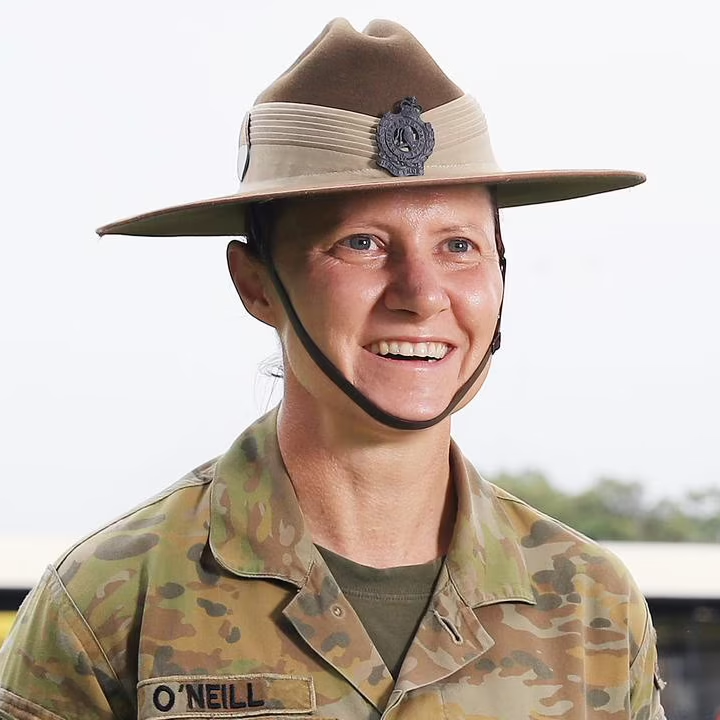
Captain Lambert is an active duty Army officer who recently served on the divisional staff and is now instructing at the Australian Defence Force Academy. He has significant regimental and operational experience, primarily within the Pacific region, and holds several degrees from the University of New South Wales in Canberra.
Captain Lambert will use his Fulbright professional scholarship in United States – Australian Alliance Studies to conduct research with a variety of governmental and industry partners. This research will explore the challenges and impacts of competition versus cooperation within the allied context on an Australian mobilisation effort. It will enable better use of Australian defence industry investment and strengthen the longstanding alliance ties between the United States and Australia.
Dr Harpur is currently a senior lecturer with the TC Beirne School of Law at the University of Queensland. He became blind following a train accident at the age of 14 and found himself disabled by society. The question of why barriers to ability exist and how they can be removed has evolved into an impressive academic and advocacy career for Paul.
Harpur will use his Fulbright Future Scholarship to spend 3 months between the Burton Blatt Institute at Syracuse University and Harvard University to collect data and build relationships between Australian and US advocates and researchers involved with the development and promotion of design that is accessible to everyone in society, whether they be able or disabled. Harpur’s research project aims to combat ableism’s influence on human life, so that in the future different ability is not associated with disablement, but instead is accepted as a part of human diversity.
Vinita is the General Manager of Advisory Services at Good Shepherd Microfinance, Australia’s largest microfinance provider which aims to enable economic well-being for people on low incomes, especially women and girls. She will use her Fulbright Professional Coral Sea Scholarship to spend three months at the Center for Financial Inclusion in Washington DC, working with their researchers and partners to explore behaviourally-informed financial solutions for those on low incomes, in particular how to motivate families to save more and borrow less.
Vinita also plans to share her learnings about the unique challenges of financial services provision in remote Australia, particularly amongst Indigenous communities, and foster ongoing partnerships with both academics and practitioners. Her Fulbright Scholarship will therefore facilitate the ongoing sharing of best-practice approaches to financial inclusion and capability-building, between the United States and the Asia-Pacific region.
Beth is a co-founding director at Humanitarian Advisory Group, a social enterprise delivering leading-edge research and advice to enable the humanitarian sector to perform at its best. Previously, Beth has held a number of key coordination roles in a range of peace operations and humanitarian response contexts, including three years in Afghanistan where she developed and implemented guidance on how aid agencies and military forces can best coordinate.
Beth will use her Fulbright Scholarship to spend three months at the US Naval War College’s Civil-Military Humanitarian Response Program. There she will explore how to improve international response to humanitarian crises, both in how aid is delivered and how civilians are protected, with a focus on civil-military interaction. This opportunity will enable Beth to further bridge the divide between these two very different worlds, so that civilians who are caught up in war and disaster can receive assistance and protection more effectively.
Adam is a proud Aboriginal Australian and descendant of the Wiradjuri people in western New South Wales. As the Director, Learning at CareerTrackers he is supporting thousands of Aboriginal and Torres Strait Islander students to obtain a university degree, pursue professional employment, become leaders of industry and role models for future generations.
Adam will use his Fulbright Scholarship to analyse the pathway to generate sustainable jobs for under-represented minorities by studying leading NGO’s and historic institutions in the U.S. His host organisation, INROADS, was founded in 1970 to address the under-representation of minorities in the boardrooms of Corporate America and has more than 28,000 graduates that have gone on to executive positions with over 1,000 major corporations.
As a Fulbright Scholar, Adam will build a Global Alliance between INROADS, CareerTrackers and other NGO’s across the U.S. to create a professional jobs consortium for under-represented minorities and unlock ongoing collaboration with a vision to elevate the social and economic impact of organisations and their beneficiaries.
Andrew is a Senior Lecturer in the Strategic and Defence Studies Centre at the Australian National University. His research focuses on strategy, middle powers and Australian defence policy. His work has been published in the Journal of Strategic Studies, Asia Policy, and Australian Journal of International Affairs, along with books with Oxford University Press and Georgetown University Press. Dr Carr is the editor of the Centre of Gravity policy paper series.
For his Fulbright, Andrew will be based in Washington D.C, to visit archives and speak to policymakers. Andrew will explore how the United States thought about and contributed to Australia’s defence of its territory in the 1940s and 1980s. In today’s environment of increasing strategic tension, this project will assist the development of Australian defence policy and the management of expectations and responsibilities in the Australia-United States alliance.
Joyce is a Research Fellow at the Crawford School of Public Policy, Australian National University. She is dedicated to women’s rights and gender equality, and has worked in domestic violence services in Australia, as well as managing the South and South East Asian regions of the UN Trust Fund to End Violence Against Women. Her PhD was on the role of men and boys in promoting equality and ending gender-based violence in Afghanistan, Pakistan and Timor Leste. Joyce has also worked on gender equity and water resource management in South Asia, through the 12-year program, Sustainable Development Investment Portfolio, which is funded by the Australian Government.
For her Fulbright Senior Scholarship (funded by Kansas State University), Joyce will be based at the Gender, Women, and Sexuality Studies Department, researching on how the University’s gender mainstreaming and diversity efforts can be replicated within the Australian universities’ context.
Mark grew up on a dairy farm on the mid-north coast of NSW where he developed a passion for agriculture and life-long goal of helping farmers become more productive, efficient and sustainable. He is an Associate Professor in Precision Livestock at CQUniversity Australia and focuses his research on sensor technologies for animals and pastures.
Mark’s Fulbright project will explore how data from GPS tracking and behavioural sensors on livestock can be integrated with satellite imagery of the pastures or rangelands being grazed. The project will be undertaken in two very different environments: the first in Ohio where soils are fertile and rainfall plentiful; and the second in New Mexico, where desert rangelands dominate. The outcomes will provide farmers with a deeper understanding of the way in their cattle or sheep are using the pasture and landscape, enabling them to make better decisions to increase production efficiency and reduce environmental impacts such as overgrazing.
John is an Associate Professor at UNSW Sydney. He leads a small group of PhD and Masters students at #UNSWSoilScienceCentral2018. His research aims to demonstrate how proximal (near soil) and remote sensing data can be used to develop digital soil maps in cotton areas of central (e.g. Trangie and Bourke) and northern (e.g. Wee Waa and Moree) New South Wales as well as in sugarcane fields of far north Queensland (e.g. Mossman, Ingham, Burdekin and Proserpine).
His most recent research has been in the use of proximal sensing electromagnetic (EM) induction instruments and application of inversion software to make two- and three-dimensional images of the soil. This innovative approach has been used to monitor soil moisture beneath irrigation systems in Cordoba (Spain) and California (USA) and map salinity and clay content in developing countries such as India (Karnal, Haryana) and Thailand (Khon Kaen), respectively.
In 2020, and as part of his Fulbright Futures Scholarship (funded by the Kinghorn Foundation), John will continue his research while at the University of Arizona (Prof Ty Ferre), Texas A & M (Prof Mark Everett and Prof Cristine Morgan) and University of Wisconisn-Madison (Prof Alfred Hartemink and Assistant Prof Jingyi Huang) with particular emphasis on studying problems of water use efficiency in irrigated systems and the impact of rising water tables and sea levels to monitor soil salinity.
He envisages that working with these scientists and their PhD students, various comparative studies can be undertaken with results leading to the publication of scientific papers in high impact geophysics, hydrological and soil science journals. In practical terms, application of the methods will provide farmers information to improve water use efficiency and soil use and management.
James is a Father Frank Flynn Fellow at Menzies School of Health Research, and holds honorary academic appointments at the University of Sydney, Curtin University, Charles Darwin University and the University of Saskatchewan. His applied research interests have spanned alcohol harm minimisation, Indigenous health/education, health literacy, and men’s health. James is a Fellow of the Australian Health Promotion Association, current Editor-in-Chief of the Health Promotion Journal of Australia, and an Editorial Advisory Board member of the International Journal of Men’s Social and Community Health.
James’ Fulbright project will focus on synthesising global evidence to improve health promotion strategies aimed at reducing health inequities among young black men. This will involve learning from recent achievements in Aboriginal and Torres Strait Islander male health in Australia, and comparing these with strategies adopted in African-American and Native American men’s health contexts in the U.S. This work will enhance international men’s health policy discourses.
Jane is the Senior Curator of Terrestrial Vertebrates at Museums Victoria in Melbourne, where she oversees herpetology (reptiles and amphibians) research. She has more than 25 years of experience in research on evolution, genetics, conservation and taxonomy of reptiles and amphibians. Her research focusses on advancing integrative approaches to understand biological diversity and how we can better conserve our unique fauna into the future.
Jane will use her Fulbright scholarship to conduct collaborative research at the Living Earth Collaborative at Washington University in St Louis. She will undertake a case study to develop an integrative approach to improving understanding of species diversity and complete an assessment of the potential contribution of improved biodiversity knowledge, through taxonomy, on conservation outcomes for Australian lizards. The project will provide significant advances in the conservation management of Australian biodiversity into the future, from methodological development to practical implementation.
Julie studies the emergence of the growing, making, selling and drinking of wine in Australia and how these pursuits have shaped regional communities, and a national industry and ethos, in global contexts. She is a Senior Lecturer in History at the University of Newcastle where she leads an international multidisciplinary network of wine studies researchers linked to the Centre for 21st Century Humanities.
As a Fulbright Scholar Julie will be based for three months at the Shields Library, University of California, Davis. This library’s archive contains the world’s largest collection of faculty, professional and private papers on wine science, industry and culture. Julie will explore collections that contain evidence of exchange in science for industry between America and Australia since the 1950s. She will highlight how these binational transfers of skills and expertise were formative for the modern wine industry and use this material to create new teaching resources.
Eric is Associate Professor in Innovation and Strategic Management, and Pro-Vice-Chancellor (Research – Enterprise & Engagement), at the University of Sydney. His work focuses on how organizations formulate and implement strategies, with a specific focus on the challenges associated with enabling strategic change and fostering new forms of regional innovation. His studies have covered firm performance in diverse settings including biotechnology, clean energy finance, fin-tech, and advanced manufacturing.
During his Fulbright tenure, Eric will collect data for a multi-case study examining the role of university research environments in fostering different types of industrial and economic development. The outcomes will inform scholarship on patterns of competition and cooperation in the fields of strategic management and regional innovation. He will also foster deeper knowledge exchange between universities in Australia and the United States, especially in the areas of large-scale Research & Development partnerships with industry, IP commercialization, and entrepreneurship education.
Philip Dwyer is Professor of History and the founding Director of the Centre for the History of Violence at the University of Newcastle. His Fulbright will allow him to develop his ideas around one of the most pressing issues in the modern world, violence and gun violence in particular, by comparing and contrasting two very similar cultures and societies, Australia and the U.S. The Fulbright will thus enable him to research changing attitudes to violence in the U.S. over time, and the conditions that can lead to outbreaks of violence.
Based at the University of Illinois at Urbana-Champaign, the Fulbright Scholarship will allow Philip to continue collaborating with Professor Mark Micale, to share and exchange knowledge and skills with other scholars at Urbana-Champaign and, importantly, to facilitate the establishment of collaborative opportunities for continuing research into the origins and causes of violence in the U.S. and Australia.
Scott earned his BSc (Hons) (1991) and PhD in Chemistry (1996) from the University of Newcastle. Following a Postdoctoral Fellowship at the University of California, Santa Barbara (1996-1997), and employment with Eveready Battery Company (1998-2001) he returned to his alma mater as the Delta EMD Lecturer in Applied Chemistry (2001). His research interests lie in the materials science and electrochemistry of energy storage and conversion materials and his Fulbright Scholarship will be spent collaborating with two noted US scientists and engineers in this field.
He will be hosted initially by Dr Chris Johnson at Argonne National Laboratory to collaborate on the development of advanced materials used to power electric vehicles, and then by Professor Bruce Dunn at UCLA to collaborate on the mechanistic understanding of energy storage in electrochemical capacitors. This opportunity will allow Scott to make significant advances in the field, as well as develop ongoing collaborations.
Kate is the Head of the Program of International Research and Training at the University of New South Wales. During her Fulbright Scholarship, she will spend six months in Kansas, establishing a formal partnership between her research centre and Kansas State University (K-State). This partnership, as well as the existing partnership with the United Nations Office on Drugs and Crime, will address many of the health issues facing prisoners in the U.S, Australia and in the developing world. Kate will use her time at K-State to build professional networks in the prison health care and research fields, to enhance her knowledge and to commence collaborative projects between the two institutions.