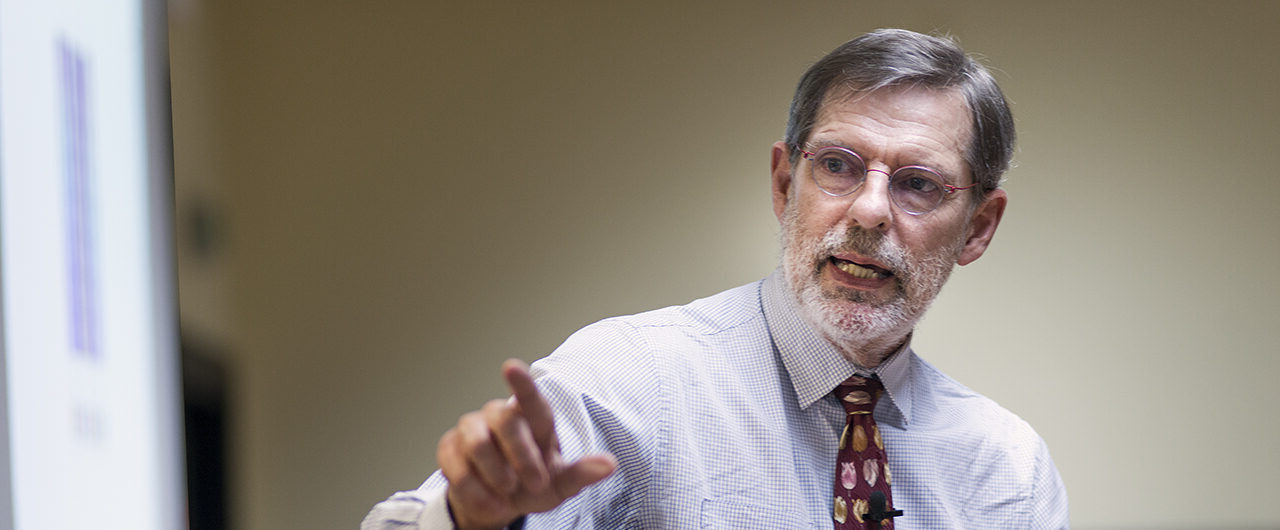
Distinguished Professor Noel Cressie, University of Wollongong Distinguished Professor and 1972 Australian Fulbright Alumnus, has received the 2026 Jerome Sacks Award from the National Institute of Statistical Sciences (NISS) in the United States, recognising his sustained contributions to cross-disciplinary research involving the statistical sciences.
The award, named in honour of NISS founding director Jerry Sacks, spotlights outstanding research that applies statistical science across disciplinary boundaries. It is the latest in a decorated career that has seen Professor Cressie make major contributions to environmental science, climate research, public health, space science and statistical methodology.
The recognition follows Cressie’s receipt of the 2025 Hannan Medal from the Australian Academy of Science. The Hannan Medal celebrates outstanding contributions to statistical, pure, applied and computational mathematics, with Cressie recognised for his pioneering and influential work in statistical science, particularly the analysis of spatial and space-time data in environmental science.
For Cressie, the achievement also marks the latest chapter in a research relationship between Australia and the United States that began more than 50 years ago.
In 1972, Cressie travelled to Princeton University as a Fulbright Scholar to undertake his PhD in statistics. He has since spent much of his career working across both countries, including as a professor and Distinguished Professor at Iowa State University and The Ohio State University, before returning to Australia and joining the University of Wollongong (UOW).
He credits his Fulbright experience at Princeton as the beginning of what would become a lifelong period of trans-Pacific research and collaboration.
Today, Cressie is Distinguished Professor in UOW’s School of Mathematics and Physics and Director of the Centre for Environmental Informatics within the National Institute for Applied Statistics Research Australia. His research applies spatial statistics, the study of how data varies across geographic space and time, to some of the world’s most complex environmental and scientific challenges.
His work has spanned global carbon dioxide fluxes, regional climate, sea surface temperatures, air pollution, disease mapping, ocean biogeochemical cycles, soil carbon dynamics, glacier movement and river pollution.
“My science is the science of uncertainty or imperfection, where I quantify uncertainties statistically,”
One of his most significant international collaborations has been with NASA, where he has been a member of the Science Team for the Orbiting Carbon Observatory-2 (OCO-2) satellite since 2010. The mission measures atmospheric carbon dioxide around the globe, helping scientists understand where carbon is being absorbed and released.
Working with colleagues at UOW, CSIRO and the University of Bristol, Cressie helped develop WOMBAT: the WOllongong Methodology for Bayesian Assimilation of Trace-gases. WOMBAT is a statistical framework that maps global carbon dioxide sources and sinks while also quantifying the uncertainty surrounding those estimates.
“Our work has been critical in understanding flux, namely the sources and sinks of CO2 on a global scale. WOMBAT maps the fluxes at high resolutions with a companion map showing the uncertainty of the estimated fluxes,”
His collaborations have extended from the atmosphere to the Antarctic. He has worked with researchers involved in the ARC-funded Securing Antarctica’s Environmental Future program, as well as on projects examining soil carbon cycling and other environmental systems.
More recently, Cressie served on a joint NASA and European Space Agency team examining the statistical assessment of biohazard risks associated with potential samples returned from Mars. The team’s report received NASA’s 2025 Group Achievement Award.
The 2026 Jerome Sacks Award therefore recognises not only an exceptional statistical career, but a body of work defined by collaboration across disciplines, institutions and national borders.
Cressie’s career is also a powerful example of the long-term impact of international educational exchange. His Fulbright experience at Princeton more than five decades ago helped establish connections that have continued throughout his career, linking Australian and American researchers in pursuit of solutions to global challenges.
As Fulbright Australia celebrates the Program’s 80th anniversary in 2026 under the theme Ideas That Change Nations, Cressie’s story illustrates how a single international exchange can become the foundation for a lifetime of research, collaboration and impact.
From studying statistics at Princeton as a young Australian scholar to collaborating with NASA on understanding the Earth’s carbon cycle and assessing the risks of returning samples from Mars, Professor Cressie’s career demonstrates the extraordinary possibilities that can emerge when ideas, people and disciplines cross borders.